Tai Chi and Travel stories

Personal stories about both learning and teaching Tai chi. It is about walking the path of self-development and finding my position in social and professional life. I have been travelling and living in many countries, speak 7 languages fluently. With the view from a cosmopolitan perspective, I have included my personal experiences in each culture.

Saturday, May 05, 2007

Dealing with ( excessive) tension in Tai Chi

This article is not based on clinical trials but rather personal experience as well as reports from patients and students.

The word "relax" in Tai Chi class very often causes the wrong perception. When the students hear the word "relax", their body becomes toneless like a wet noodle. "Relaxation" has some negative taste like total lack of awareness. In Tai Chi or any other type of martial arts, focus without overconcentration is most important. The Chinese word is"song", but students are confused enough with the teachings, so we better don't torture them with Chinese words.

One of my colleagues, Tai Chi and karate master Steve Rowe, suggested the phrase:" Get rid of excessive tension". I like that. We do need a certain tension or tone to maintain our posture and balance, otherwise our body will be just a heap of soft pudding on the ground.

How can we apply our practice in our social and work environment?

Life can be very stressful in a fast-paced world. Many people come to a Tai Chi class hoping they could reduce their stress and tension. But first we need to look for the reasons as to why we are tense. It is genetically determined that one person is more tense and thus more prone to stress than the other.

Basicly there are two types of personalities:

1. The A-type of person, primarily determined by the sympathetic nervous system with a high adrenaline activity. These people are more agressive and the negative forms tend to lead to uncontrolled anger and tension. The positive traits of these people are ambitious approach of everything they do and a tendency to perfectionism

2. The B-type of person is more determined by the parasympathetic system and lower adrenaline activity. These people are more laid-back and not easily provoked

A-type people are mostly very professional and have reached high achievements in their lives. Tai Chi Chuan has a high impact on both the sympathetic and para-sympathetic system. An easy-to-understand explanation would be the relaxing components of the slow, flowing movements and the deep abdominal breathing enhances the para-sympathetic system. The more active parts like kicks, punches and fa jing(explosive whole-body force exertion) supports the sympathetic system

Let us look at the slow movements as the relaxing yin components and the active fa jing(force exertion)parts as the yang . This means that there would always be the yin within the yang and vice versa. Tension within relaxation, relaxation within tension is one method which is also practised in the Jacobsen relaxation techniques.

There are two different types of stress:

1.Positive stress or Eu-stress. One example is the type of stress we experience on completing a difficult task. When we master this task, we experience an immediate reward which makes us feel that the stress was worth going through. Eu-stress may become necessary for us to meet the challenges in life.
2.Negative stress or dis-stress. Stress which is destructive like abuse by family members or job with high effort and low reward.


Which group of people is more likely to experience negative stress or dis-stress ?

1. When an A-type of person works in a stressful environment with virtually very unhealthy, small and one-sided movements, tension is hard to control. Dentists and those who work with the computer have an unreasonably high exposure to this type of movements.

2. People who have been traumatized in their childhood and low stress-tolerance

3. Those with low stress tolerance who are experiencing loss of loved ones or constant abuse


Which home remedies may possibly help?

Good Tai Chi chuan needs a relaxed mind and body to execute the forms correctly and develop martial skills. Many students who live and work in an unfavourable environment are tense before they come to class.

Massage treatment and full bath with essential etheric oils are so-called passive stress management interventions. During these treatments, one can practise mental clarity in a light meditative mental state. It is a good opportunity to cleanse the thoughts from everyday problems and focus on breathing or how pleasant the experience is. Remember this positive experience and the feeling you get afterwards. Continue to remember it and transfer to physical TAi Chi practice later on.


Additional practice outside direct Tai Chi practice:

As my teacher Chenxiaowang put in his numerous seminars:" Tai Chi is abstract and not concrete. One should not fully concentrate because it will cause tension and too much obsession on just one aspect. The mind should therefore consist of one part considering the form, the other part should be free and enjoying the practice." Practising this type of mindset in the bathtub, at the doctor's surgery, in the plane and bus or even in front of the computer will support direct Tai Chi practise

The mind is the general who works out a strategy and gives orders, the body is the army who carries them out.When the mind is tense the body will be tense up. However, when the body is tense due to movements against natural physiology, the mind will receive it back. Exactly like a bad general who is the head of a good army or a good general whose orders are not understood by an incapable army.

Zhan zhuang or standing meditation, posture holding, reeling silk qi gong, sitting meditation in the plane, train, at the computer or when sitting in a doctor's surgery are very good means to achieve mental clarity. Brisk and nordic walking is considered to be the best sport to train posture, balance and internal connectivity. Chen Yingjun recommends walking to most of his students.

Labels: , , , ,

Wednesday, March 07, 2007

Guided imagery and Catwoman

Too much guided imagery will cause tension, a well-taught point in Tai Chi Chuan. Some people tense up after too extensive guided imagery in Sun Style open/close hands. Although I have now stopped teaching Tai Chi for Arthritis and Sun style,I remember teaching many advanced aged people with minimal experience in Tai CHi and general exercise.

Some guided imagery was provided but I gave several short reminders to keep posture and alignment, to stay relaxed and focused. I deliberately did not give too much guided imagery on energy during open/close hands. Some hints on a magnetic force keeping their hands from closing and opening was the only visualization aid I gave. The students had no problems at all and quite a few of the inexperienced Tai Chi practitioners reported energy between the two hands.

It must have been a very bad day during a form correction with my teacher Chen Yingjun. I was tired and apparently did not step light enough. The brushing and dragging kind of stepping in Chen style is very likely to encourage heaviness in the stepping leg if someone is not focused enough.

Chen YIngjun was quite disappointed as I still made the mistakes of double-weightedness, something I should not make after close-corner training with a member of the Chen family. He showed me a few movements and I copied them.The improvement I made was so drastic that I became worried that it would not last for a long time How was it possible to change so dramatically; it was like two different people performing? Chen Yingjun was flabbergasted at the changes I was able to make with just minimal instruction.

But what happened on the day before I copied Chen Yingjun? I love to watch the DVD movie "Catwoman" featuring Halle Berry. However, this time I had more time to watch the actual making of the movie in detail. Halle Berry performed most of the stunts herself and spent hours of studying and copying cat movements.

She has been watching many different documentaries of cats moving and fighting their peers before training with the action choreographer. It was an inspirational discovery for me. It was like a movie passing through my inner eyes as I saw my two Siamese cats playing together or stalking around a mouse before finally jumping to catch it.

Stepping needs to be light, said Chen Yingjun. But was Tai Chi Chuan(Taijiquan)not created after the masters observed animal movements for hours and years? How does a cat move and how does it step? I have never seen a cat stepping heavily like an elephant.

Catwoman's memory was resting in the back of my mind and I subconsciously imbibed it. In the next lesson, the other students in YIngjun's class observed my body to become more aligned, the shoulders, arms, hands were better linked together as I moved. Grandmaster Chenxiaowang's words was like a tape being played to my inner ear: 50 % of the thoughts focus on imagery and the other 50% free and enjoy.

This was a breaking experience for me and I continued observing cat and tiger moves in the zoo. Halle Berry was a capoeira practitioner and she imagined cats would fight very similar to this; rolling on the ground, winding and unwinding. But how would the next Catwoman move when she practiced Tai Chi Chuan? Let us see into the future when the next generation Catwoman would be a Tai Chi practitioner.

Labels: , , , ,

Thursday, February 22, 2007

Singing technique with Nadia

Yesterday our choir had an extraordinary lesson with Nadia. She was a radiant personality; as she walked into the room it was as though we were embedded in her qi. She had no previous experience with Tai Chi. I know that many physical exercises in singing have to do with breathing and the movements resemble Tai Chi to a great deal.

She started off with theory and the first three odds of singing:

1. Posture
Imagine our head is straight and suspended by a string from above. Our shoulders sunken and in singing they simply do not exist. Back straight and torso prolonged, the hips slightly bent and relaxed, the tail bone low and not protruding too much. Our voice clearly became better as soon as we were more aware of our posture

2. Breathing
A short explanation of breathing physiology, how the abdominal muscles were organized and utilized. The shape and role of the diaphragm during exhalation. Singing is factually a procedure of exhalation. In short, singing is not carried out by the throat but by the abdomen.

3. Using the whole body. The bones are the resonance body for the sound, low tones are produced by the chest bones, higher tones(head voice) by the facial bones

Our posture and stance needs to be heroic, nearly arrogant. When I sing or practice Tai Chi, I now imagine being the hero Radames in the opera Aida. In the older days the scholars and the singers played a core role in social hierarchy. the people who were being listened to. Speaking should be rhythmic, clear and slow, the tone of the voice low, dark and calm.

The singers I know have extraordinary levels of qi. "Singing is positive energy, you need to be in high spirits and keep your mind clear from disturbing thoughts." said Nadia

Tai Chi would be an excellent complement for choirs and opera singers because they have so many aspects in common.

Labels: , , ,

Monday, February 19, 2007

Relationship with a Tai Chi teacher

Why do you do Tai CHi? Why do I do Tai Chi? Some people do Tai Chi because they have seen Kung fu movies, some are looking for a better life, many do it to destress, to teach themselves to become more patient, to develop more body/mind awareness and a great deal for health and therapeutic reasons.

Some people are not prepared to do long standing meditation, a seemingly arduous effort with no immediate gratification. It does have a significant reward on the long run, such as a better natural posture, mental quietness, the type of relaxation which has more to do with stretching and loosening than a spaghetti type of relaxation(song), clear strengthening of the postural and leg muscles.

High push hands skills is a result of regular standing practice. One needs to stand as long as h/she is able to and just 1 minute will be enough for the start. This is the way to really listen into oneself, the body, the breathing, sensation of left and right, the right posture, in fact something with an extremely high reward.

I have practiced several martial arts and they all have high health benefits. As Tai Chi became more and more well-known in the western world as a health exercise I thought that practicing this art for both martial arts and health would be the real supreme ultimate. My encounters with Grandmaster Yang Zhenduo and later my shi gong(Grandfather-teacher) Grandmaster Chenxiaowang was the fulfilment of my dream. Dr. Paul Lam has shown me a way to combine my medical skills with Tai Chi Chuan, another refreshing flavour in my path towards the ultimate balance.

All my teachers have been excellent as both teachers as well as martial artists. But what will be the case when somebody is unable to get hold of a suitable teacher in his/er area? Should this person put up with a seemingly skilled person but very poor people/s skills? Are we all not just vulnerable people with some insecurities, ordinary sinners with all needs for love and reward? If we are made to feel incompetent by a teacher, justified or not, will we develop into incompetent learners?

Push hands skills like reaching out where the "insults" come from(of course we know this), absorb them, redirect and transfer it into obtaining skills sound wonderful in theory. But.....exactly like push hands skills need a solid structure through formwork, mental push hands need a solid structure through constant efforts.

I heard comments like you emulate more to the person you like to be through long-term practice. A teacher who communicates downward does not make it possible unless you are a member of one of the Chen or Yang family. Well....I wanted to be as good as Grandmaster Chenxiaowang or at least like his son YIngjun or my teacher Jan Silberstorff. When I practice I imagine to be one of them and I really try to practice in such a way that I externally resemble one of them.

The Toastmasters'(a group of amateur public speakers) have a golden rule:PIP(Praise, Improvement, Praise). It is of utmost importance to receive praise for the efforts and the path towards better health and Tai Chi Chuan. The journey towards the goal is as important as the goal itself. A good teacher needs the right attitude and communication skills, to balance between praise and improvement.

Labels: , , ,

Monday, February 12, 2007

Tai Chi principles and Salsa dancing

This article is purely based on my personal experience. People with physical limitations are not recommended turning without proper instruction from a professional. Please discuss with your health care practitioner before following any examples."

Tai Chi has the right principles and internal strength, dancing is just mindless moving and Tai Chi principles is simply alien in this group." A very common, most erroneous statement from those who practise Tai Chi without any connection to the real world. My salsa teacher Oren has proven that it is totally different.

In the first lesson he emphasized on relaxation of the mind and the right posture without technical words like jing or qi. He and his partner were humourous and entertaining, but their teaching was thorough enough to give the students what they expect. He was standing back on to the students, exactly like a Tai CHi teacher.

From his teaching style he reminds more of a Tai Chi teacher than an emotional dancer. HIs explanation of the single turning could have come from a Tai Chi instructor. He broke the movement into three parts. The first part was placing the left foot for the ladies in front of the body. In the next part, the students should pivot on the ball of their feet from their centre(he pointed at the dantien).

Shift weight from left to right where he placed high emphasis on. Prepare for the next 180 degree turn. " You can't turn on a foot when there is no weight on it." he said. Turning should be on the ball of the foot with some weight, but not so much that the foot is planted in the ground. Maybe he does practice Tai CHi because this is taught in many dance studios. No difficult words like yin, yang, little yin in the yang and vice versa.

The gentlemen needed to give slight pressure in order to lead their ladies into turning, while the ladies needed to give slight resistance despite relaxation."No spaghetti type of relaxation." said Oren.The arms well-angled but the ellbows should not be too much out. No words like song and qi.Pink Barbie pushed a little bit too hard and her partner tumbled over very slightly.

The legs should be bent but the knee should not protrude over the foot. Hey.....very familiar. The body will become well-balanced when the hands and feet are in the right position.

Our body responds with the same natural angles to physical motion, so dancing is certainly an excellent way to obtain many of the Tai CHi principles. On the other hand, Tai Chi teaches us so many ways to apply principles and internal strength in our life.

Labels: ,

Thursday, February 08, 2007

The levels of Taijiquan learning

Grandmaster Chen Zhonglei has given a presentation about the levels of Taijiquan. Jan Silberstorff, my teacher, has stated similar points relating to the hexagrams and images. Following levels will be easier understood for the general public.

1. Learning the movements on a gros level. Some corrections on posture, focus, relaxation. Introduction into martial arts guided imagery to make the movements to be better understood. Gentle introduction into the essential principles and qi(vital energy)

On this level, a beginning teacher with good movements would be able to help. A good video, dvd or book is better than a bad teacher. When the students wish to explore the higher levels of the art, h/she will have to look for a teacher with a higher level and a video will not be enough The attitude and teaching skills of the teacher plays the most important role on all levels

2. Refining the movements in detail. Further introduction into the essential principles by Chang Cheng Fu. More guided imagery and maybe soft partner training on martial applications. The movements will become more accurate with the right intention and understanding. Gentle introduction into weight shifting, substantial(yang) and insubstantial(yin). Further introduction into qi dynamics, trying to move with the qi

3. Moving with the qi and trying to infuse the qi into the limbs and the body. Further instruction to communicate qi to the muscles and body. Deepening the understanding of yin and yang, little yin within the yang, little yang within the yin. In the I Ching this is called the level of the four images

Tai Chi is a life-long endeavour. Not only will our inner and outer muscles develp more strength and volume, our character will grow as we walk along the path of the Dao. Playing the form means listening into our body, how it changes gradually from wuji(void) into taiji(balance of yin and yang), further divide itself into yin within the yang and vice versa, everything will divide into the many little particles of yin-yang-yin-yang. Finally everything will return to the origins, to the large scale of yin and Yang and to Wuji(closing movement)

Labels: , ,

Thursday, February 01, 2007

Young kids and Tai Chi


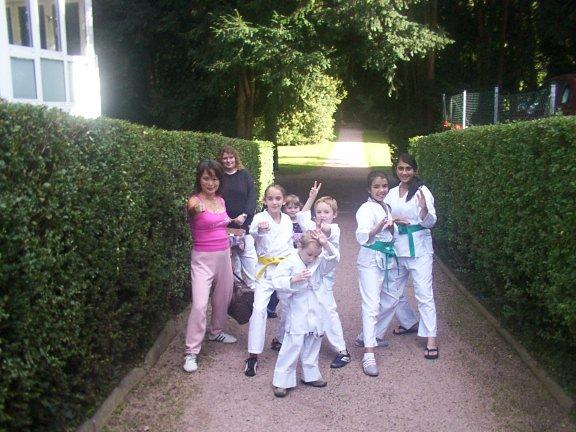
Junior practices karate and some Tai Chi. He has a lot of energy and a good eye to copy. Obviously he does prefer the flashy jumps and kicks of Chen style. On the outer appearance, it is much more similar to external arts than to what the general public erroneously perceives as Tai Chi. The rest of the class is practising posture and weight shifting. Not as easy as meets the eye.

Labels: , ,

Saturday, January 27, 2007

Tai Chi after a big night

Warning:
The article below is based on personal experience and by no means considered medical advice. Please consult your doctor before following any of the examples and stories


Hangovers are multicausal; as an example a few studies of which remedies may help the symptoms of a hangover has been published by the British Medical Journal. Dr. Max Pittler from the Peninsular Medical School in Exeter has researched a few common home remedies. I would like to mention a couple of them before I proceed into the details of how Tai Chi relieved my hangover:

Eating sugary and starchy food
Drink plenty of water
vit B12, Ibuprofen as for the inflammation, Aspirin or Paracetamol
The "hair of the dog" remedy like drinking more alcohol than the night before
Mild exercise like Yoga or gymnastics, a gentle Tai Chi form like laojia yilu

These remedies have been studied with reasonable results and very effective for my needs. Tai Chi makes the blood flow more constantly. Traditional Chinese Medicine suggests that Tai Chi makes the qi or vital energy flow better, improves blood circulation, de- and rehydration..

After a big night, I practised in the park near Bondi Beach. I had my new bikini on and just thought could practise a few forms. There were not too many spectators except the families and other martial artists I knew. In the beginning, I had to overcome the demon within and my form was not particularly strong.

However, after the first reeling silk exercises and two rounds of laojia yilu,I began to feel a warm, friendly energy spreading throughout my whole body. Between the forms I had some iced water and Tim Tam Latte. My initially stiff kicks became more flexible and strong;I could hear the usual strong patting sound. I felt calm and content, proud that I could overcome my hangover. I don't suffer a hangover very often. It needs a vicious mix of alcohol consumption to make me feel the symptoms of a hangover. Half a bottle of ginger Whiskey(sweet Bourbon with ginger), an uncontrolled mixture of beer and wine of approximately the quantity of one whole barrel was enough to do the job.

It was Australia Day when Chen YIngjun offered us a class at his house. I came to his house with a big head and started off with 3 reps of the sabre form. Weapons are the best weight training in Tai Chi I could think of and tried YIngjun's heavy new sword.I asked him whether he noticed my hangover and he said:"NO." Probably he was too polite. Anyway, I felt my blood flowing better and I naturally took a deeper breath.

My water consumption was higher than usual but I did not expect that my form was relatively centered after so much booze consumption. On the same night I returned to the city and had more booze.......The "hair of the dog" remedy plus Tai Chi was most effective!!!!

HOwever, there is no real cure for a hangover because the body needs a certain amount of time to dehydrate and excrete the alcohol. One of the above remedies may help some people to alleviate the symptoms. Recent research has shown that psychological issues seem to have an influence. Somebody who is predisposed to depression or who generally expect to experience a hangover after a night of alcohol is very likely to feel the symptoms. Some people never have a hangover, some others develop it after just one pint of beer. The levels of ethanol in the blood are however more dependent on weight, health and food intake

Labels: , ,

Wednesday, January 24, 2007

Chen style for the health-compromised

There are many methods of teaching Tai CHi. Traditionally there are many teaching methods and these are very black and white. Just to mention how to memorize a form: My teachers have been traditionally taught how to observe their teacher, give up themselves and follow. It is by no means just monkey sees monkey does. After following my teacher for some time, I experienced somethng in my body had changed. Apart from the movements I also felt that I started to feel without seeing. My awareness increased, I sensed mistakes and could correct them nearly instantly. I sensed my center of gravity, whether the body is balanced or not, how rooted or uprooted I am, what application the movement is all about........I was able to listen into my own body.

When a newcomer comes to the class, h/she is urged to follow the group and do the form, right or wrong. The teacher emphasized that one does not see oneself. If we focus too much on what is wrong, it will result in unnecessary tension. The newcomer can copy the movements as well as s/he can; the more advanced will get different information for their level. Subconsciously the beginner will imbibe the advanced information as well. After the plenary session with the group, the large group is split up into smaller groups. The beginners or those who do not practise will always be taught a new movement without slowing down the more advanced.

A person with limitation and critical medical conditions is very often unable to lead a normal life. These people may need a special class and attention. It depends on the sensitivity of the teacher how much this group of students is prepared to learn the form or just to enjoy social interaction and some exercise.

Chen style is the oldest style and the origin of all other styles. Most Chen style forms are athletic, characterized by low stances, jumps, stomps, obvious martial movements, fast and slow intermixed. However, the main characteristic for Chen style is not the above mentioned outer appearance but sophisticated spiral force or reeling silk.

The reeling silk qi gong and short forms are an excellent way for the less athletic practitioner to obtain the very high health benefits. The muscles and tendons are stretched well by the joint rotation caused by spiral movements. Apart from this, the inner organs like the heart or intestines receive a gentle massage through the twisting and uncoiling movements. The body is squeezed like a sponge which results in better lymph drainage.

A good teacher who has a certain sensitivity for the students will be able to teach the students with physical limitations. It is important that the teacher works in cooperation with doctors and physical therapists. A medical training would be ideal but it is not really necessary.

Labels: , , ,

Sunday, January 21, 2007

Playing the form

It is nearly impossible to play a form exactly like another person. We are all made up of different material and within ourselves, our body cells constantly renew and decompose. The principles are all the same: focused, relaxed, rooting, balanced, centered. A good posture and alignment apart from the appropriate martial applications. The movements needs to be in accordance with the intention of the creator of the style and form.

I have already experienced myself that every time my form feels different, the energy flows differently and the intention varies from moment to moment.

There are times that I play extremely slow to be able to experience the inner awarenes of my body and mind more intensely. Some other time I reduce the time to 7 minutes only while I can still feel the inner energy spiralling from inside. When I have just been working with GM Chenxiaowang or his son YIngjun I feel their energy being magically being transferred to me. A feeling I cannot just share with words; it is a sensation of being submerged into their power.

I still feel that my postures like Dragon on the Ground, Falling Lotus, Lotus kicks, Double Jump Kick needs some improvement. My teacher Jan correct Que Di Long more as sitting into the right leg. Indeed I could feel the difference between substantial and insubstantial a lot more.At least I try to maintain rooting and balance, acting from inside the center all the time. After my positional vertigo last year, I have developed some avoidance behaviour while executing slap kicks. Now that I hardly experience the vertigo, it is becoming better but sometimes I have to start all over again.........

Labels: , , ,

Wednesday, January 10, 2007

Practise the principles in life

HOw can we practise and embody the Tai CHi Chuan principles? There is no other reasonable answer than going through the form. It incorporates all the principles and with the guide of a good teacher, as time goes by we discover the principles by feeling the changes in the mind and body. The journey is a lifetime discovery, layer for layer within the form and everyday life.

"I work the whole day, coming home with a bad mood walking through dreadful weather." said one of my students. It is only reserved to a few; dedicating our whole life to Tai CHi and practise 8 hours a day like the big guys out there. Most people need to fulfill their daily tasks in family, job and life.

My students come from different walks of life and through them, I could find out that Tai CHi principles can be practised anywhere in any activity. Just a few of the many activities we can practise our principles:


1. Sitting in front of the computer, train, aeroplane, waiting at a doctor's surgery

We practise the head straight like suspended by a thread from above, the back upright, shoulders sunken, mingmen(lower back area acupuncture point) expanded laterally(to the side). Imagine ourselves relaxed and not floppy: Our vertebraes(spinal parts and joints) separating from each other; our spine is stretched and we become taller.

2. Surfing, skating, skateboarding, skiing, walking

My main sports which I competed in the Olympics(figure skating). In these disciplines, maintaining our center and balance is crucial. Those who play these sports hear it all the time from their coaches:" Shift weight!!. Weight on right/left leg, look right or left."

3. Chopping onions

Chefs teach their students similar principles. Relaxed, the arm and fingers only the lead, everything comes from the whole-body movements. The force comes from the center. Keep natural angles in your arms.

4. Vacuum cleaning or pushing a car

Move with the strength of the legs, use the power of weight shifting. Force from the dantien leading to the arms and hands, back aligned with the rear leg. Chen style "Pushing the mountain"

5. Dealing with abusive people

Keep the thoughts on the center and balanced, physically and mentally. Take a deep breath into your abdomen, cleanse your thoughts from all dirty thoughts but maintain focused on your goal. Do not use brute force against brute force. LIsten, find out where the energy is, redirect, yield, use his own force against the opponent after unbalancing him. "Grasping the sparrows tail" Yang style


There are many opportunities in life to practise Tai CHi CHuan principles. It does not replace our daily qi gong and form practise along with push hands and applications, but it is a most effective complement.

Labels: ,

Thursday, December 21, 2006

Chen style 56 competition forms


The 56 competition forms is composed based on the movements of the first and second routine of the New Frame. The purpose is the opportunity for the judges to judge the correctness of the movements. This was the first Chen style form that I have learnt which inspired me to pursue my studies of traditional Chen style with the Chen family

Labels: , ,

Tuesday, December 19, 2006

Tai Chi woman in South Tunisia

The first tip I would give is: Never rely totally on guide books. Be self- confident, read some books about the culture but do gather your own experience.

A woman travelling alone is much better off when she does not reveal too much skin. Tunisia is a relatively liberal Muslim country but when you are not prepared, you can be harassed or touched by men. Tai Chi principles were truly helpful in getting around without being too discouraged by sexism and how to counterplay against it.

I have been travelling alone through South Tunisia and very much to my surprise, I experienced no more advances than in any other country. The first time I arrived in Douz from Tunis, where I worked in the hospital for 6 months, I was asking for a taxi. " This is not Europe, this is not the North." was the answer, as though North Tunisia was the same as Europe. Later I have been told that the European culture and civilisation has invaded much of the northern part of Tunisia.

It was not until I arrived here that I realized how large the gap between the northern and southern part was. Time seemed to stand still in medieval 1001 Nights' Douz, only 500 km from touristy western-influenced Sousse. Douz is located in the middle of the Sahara desert, a total contrast to the mundaine North Tunisia. It was just after one week that I realized that the Western culture started to infiltrate into this living fairy tale in the middle of the sand ocean.

The South is more conservative and tries to maintain their Muslim tradition in a lot more fundamentalist manner. I asked questions and they invited me into their home to talk to the women. The younger girls spoke very good French and the youngest, Farida, very proudly showed me her French essay about the differences between mammals and other animals. She wanted to become a doctor later.....

The deeper discussions with the family gave me the insight that apparently my half Asian looks protected me a little bit against harassment. I was simply a sexless creature, a figure from a Kung Fu movie. In Tunisia, women are stereotyped: Europeans are easy sex objects, Asians are martial artists and indeed they told me they were afraid I was going to hit them. My daily Chen Tai chi practice including punches, kicks, straightsword and sabre forms with a retractable sword obviously gave them evidence that an Asian looking woman was exactly like the one in the Kung Fu movies.

Many men treated me like a man and called me"monsieur" or "mister", offered me friendship tea and I was nearly always dressed in tracksuit to emphasize their already prejudiced perception. Little boys and even girls were gathering around me as I was practicing tai chi, especially the weapons forms.

My favourite means of transport is the louage or shared taxi. I have a warm heart towards Tunisia and observed locals first as they prepared to pay. One should never ask the driver for the price, I simply paid what the others paid. A nice "S'bah el chir(hello)" instead of the French "bonjour" would win a lot of sympathy . They still recognized me as a foreigner of course and answered in French. But I think they did appreciate my efforts. Many local women commuted on their own to sell their crop.

I became more courageous and started to drink tea in one of the cafes. They told me that they thought I was a foreigner who worked for one of the companies in the big city. I travelled from Douz to cross Chott el Jerid, the great salt lake. My high hope to see a fata morgana(air image) did not come true. It was too cold on that day. The movie"the English Patient" was shot in this area and since then it became more touristy.. I went there by public bus instead of the tourist train and gained some more insight about life and people in the area.

You will see people in their traditional Nomad attire accompanied by their camels. next to young girls in blue jeans talking on their mobile phone, listening to music and smoking in the streets. The German travel agencies told me that I should be aware of people travelling with animals in public transportation. Bogus!!!! They only want to suck the money out of the tourist' pockets.

A policeman told me that it was a law not to take animals in public transportation and it was strictly adhered to. The public buses are totally safe because they are government-owned but share taxis can be dangerous because they are private and dependent on the amount of rides they make. In this country it helps a lot if you speak French because this is the second official language in Tunisia.

Tai Chi chuan, especially the martial Chen style forms, made me more self-confident and gained me some respect of the local men. I would recommend every woman who would like to travel alone to prepare well, prepare her emotions when they are touched by men and do a little Tai chi form martially. Try to find out more about martial applications and pretend that you can do them very well.

Every form including Tai Chi for Arthritis should be practiced with the attitude of a predator. It will make you more self-assertive. Put a wedding ring on in Muslim and Southern European countries. Look for forums to share your feelings so you will never feel alone and experience too much of a culture shock. The teachings I received in Tai Chi has guided me and provided me with both the right martial and mental attitude.

Labels: , ,

Saturday, December 16, 2006

Female Tractor and Pink Barbie

As my teacher assigned my new partner to me, I thought:" Wow.....is this a woman?" She was barely taller than me, but my Xray eyes scrutinized through her body and I saw heavy bone and muscle mass. At the very moment I gave her the name"Female Tractor" in my mind. For privacy reasons I will not mention which country she comes from because I have been sparring with many tractor type females in many countries.

Female Tractor(FT) and myself started to push hands as relatively novice fighters. She was strong, it felt like a brute disco doorkeeper without any understanding of internal strength. I was not very experienced, neither with brute nor internal force. With my just 100 pounds I had to push against FT in lowest stance. This was the very moment as I thought that everything my teachers taught me was wrong because brute force was certainly better than no force.

"You have a good structure and posture and your body is athletic, your rooting good. You are relaxed enough to absorb somebody else's force." said my teacher. "Ah well, just words." I thought. But I tried to follow his advice and apply what I could remember of the principles. Indeed it was hard for anybody to push me because of my relaxation, body-mind coherence and rooting. My listening skills, however, especially combining it with internal strength was simply not developed enough. Everything I could express through the solo form was forgotten as soon as I came into contact with real resistance from a stronger person.

FT and me had long sessions of pushing hands. I watched her practicing long hours of the solo form, slowly and patiently. Her form visibly became softer and I could feel more softness and patience in her pushing. At the same time my muscle force improved through pushing hands and weapons training. It was not until yesterday that for the first time I could push her off her feet with uprooting techniques. Yet I noticed a soft internal force coming from her body which felt stronger and absorbed part of my own force. I have been practicing for a few years since the first time I pushed with FT and apparently my internal force(jin) improved along with my muscle strength.Chen style forms are very effective when it comes to natural muscle development, as opposed to forced weight training.

The experience is invaluable: Various types of people cultivate their internal strength by taking a completely different path. Sometimes it starts out with more native muscle force like FT. On the other hand it does not occur very seldom that a person like myself who is a figure skater to start out with body flexibility and mental support. Eventually it will develop into the more jin force as well as outer muscle strength. FT and me have become good sports mates and we still laugh when we think back of the first time we pushed together......

Labels: , , ,

Friday, December 15, 2006

Guide to use Tai Chi principles

We have all read many books and articles, our teachers have been telling us many aspects of the essential principles. The issue is: How many of us are particularly puzzled with the TCM(Traditional Chinese Medicine) terminology and philosophical ideas? It is easy to talk about it but it may take to work on them layer for layer. The ideal way for beginners would be to work on one principle for a set time and then take a journey into its depth. Later when we are more familiar with them, we may work on all of them at once but focus on a specific aspect for a certain period of time, say one week?

My former clinical teacher once told us that we should memorize everything in three main points, then subdivide each again in three main features. This is the way I am going to elucidate a summary of the 10 essential principles standardized by Yang Cheng Fu.

A. Posture

1.Head straight and light, as though suspended by a string from above
2.Shoulders and elbows relaxed and sunken
3.Back straight, waist relaxed, hips flex, imagine the lower back(acupuncture pt. MIngmen)
expanding sidewards.


B. Mind state coordinated with the body

1. Tranquility/serenity of the mind, cleanse the mind from all thoughts
2. The intention/will or implied mind drives the body, not brute force
3. Absolute harmony between the internal and external, all movements come
from within.


C. Whole body coordination and movements

1. Proper weight shifting. Focus on the center(dantien), about 3 fingerbreadth below the belly button. Maintain body balance
2. The upper coordinated with the lower body. The arms should have the same speed as the
legs
3. Absolute continuity like silk being reeled from a cocoon. No stops inbetween, only a halt


You see, a beginner may start with the posture because other sports or physical activities such as singing work with the same posture requirements. It is visible on nearly all good videos.

Labels: ,

Tuesday, October 17, 2006

Tai Chi Or Karate?


After Tai Chi class, we compare martial arts applications between Tai Chi and Karate. We like to learn from each other and compare the differences. Tai Chi form starts slow and becomes fast at an advanced stage, karate katas the other way around.

Labels: , ,

A Thought Is Just A Thought

Everybody of us knows that we need to cleanse our mind from all our thoughts and focus on what we are doing.

But how much of us are actually doing this all the time? We think of our business appointments, bills, family, planning the next day etc. However, there are a few little tricks to help us focus better.

Well, a thought is just a thought. We need to be gentle with our thoughts. When we notice they are wandering, just gently bring them back. To be more down-to-earth, we compare it with an autopilot adjusting the aeroplane when it gets off track.

My virtual Tai Chi friend TonyK from UK once told me that it was like watching a good movie, relaxed with a gentle focus rather than intensive concentration of threading a needle.

Another tip would be: engaging our brain with some of the Tai Chi principles for instance the head or back straight, hips relaxed, breathing etc. Studies also have shown that the brain goes catastrophic when it is not engaged with a task.

Different things work differently for different people. When I just keep being empty and enjoy what I'm doing, I can focus very well. Try it out and enjoy your practice. This can also be applied to other tasks or sports

Guided imagery has been one of the main tools for Tai Chi Chuan masters as well as for world class athletes. My favourite imagery is:"Walking along an empty beach, the colour and sound of the deep blue sea, the view and smell of the white sand, the mountains and forest in the background." My mind becomes tranquil nearly immediately.......

Labels: ,

The Idea Of Tai Chi In Business

We certainly know the many therapeutic benefits proven in many scientific studies. Tai Chi is an ancient Chinese martial art with practical self-defense on the street.

The concept of Tai Chi is not meeting brute force with brute force. It is rather listening to the incoming force, touch, absorb this force and redirect. On the other hand the same hand which redirects keeps focusing forward, at any time ready to attack.

Tai Chi classes are widely conducted in corporate settings. The stress reducing effects are well proven in clinical trials. In a business negotiation we would not like to attack but rather achieve our goals in a satisfactory manner against the counterparts' objections.

Tai Chi's idea of yielding instead of force against force, finding an opportunity to put across our business makes this wonderful art a very helpful tool for management and working staff alike.

Labels:

Monday, October 16, 2006

Some thoughts about the Dao

The Dao or The Path is foundational in Tai Chi. This link may be useful:

www.dimsum.co.uk/forum/viewtopic.php?t=859

Labels:

24 Beijing Forms class in the park


Karate students need Tai Chi(24 forms) to make their movements flowing and bodies flexible

Labels: ,